In 2026, most contractors are losing jobs not because of their ad budget, but because of a 5-hour average response lag. By automating your initial outreach, you can capture leads in seconds, even while you are physically on a job site, and secure the 21x qualification advantage that slow-moving competitors are leaving on the table.
The 5-Minute Reality: Why Speed Still Trumps Spend in 2026
You might think that winning more jobs is a simple matter of dumping more cash into Google Ads. In our experience, that is the most expensive way to grow. The real growth lever is not how many leads you buy, but how many you actually talk to.
Foundational research from the Lead Response Management study (2007) and corroborating data from Velocify (2014) established that responding within 5 minutes leads to a 21x increase in qualification odds compared to waiting 30 minutes. While that data is older, recent industry benchmarks confirm that the principle remains the gold standard for high-intent home services. When a homeowner submits a request, they are usually holding their phone. If you answer while they are still in that mindset, you are a solution. If you call them back the next day, you are a nuisance.
The Contractor’s Bottleneck: Why Your Lead Latency is Costing You Jobs
The biggest lie in the trades is that you need to be glued to your phone to be responsive. If you are up on a roof, you cannot pick up a phone. Most contractors accept this as a cost of doing business, but it is actually a systemic failure.
Across the clients we run, we see the same pattern: contractors spend thousands to generate interest, only to let those leads go cold because they are busy doing the actual work. We recently helped a roofing client automate their initial SMS trigger, which resulted in them booking 3 extra jobs per week without increasing their ad spend by a single dollar. You do not need to choose between being a great technician and a responsive business owner.
The 2026 Benchmark: How Your Response Time Compares to the Industry
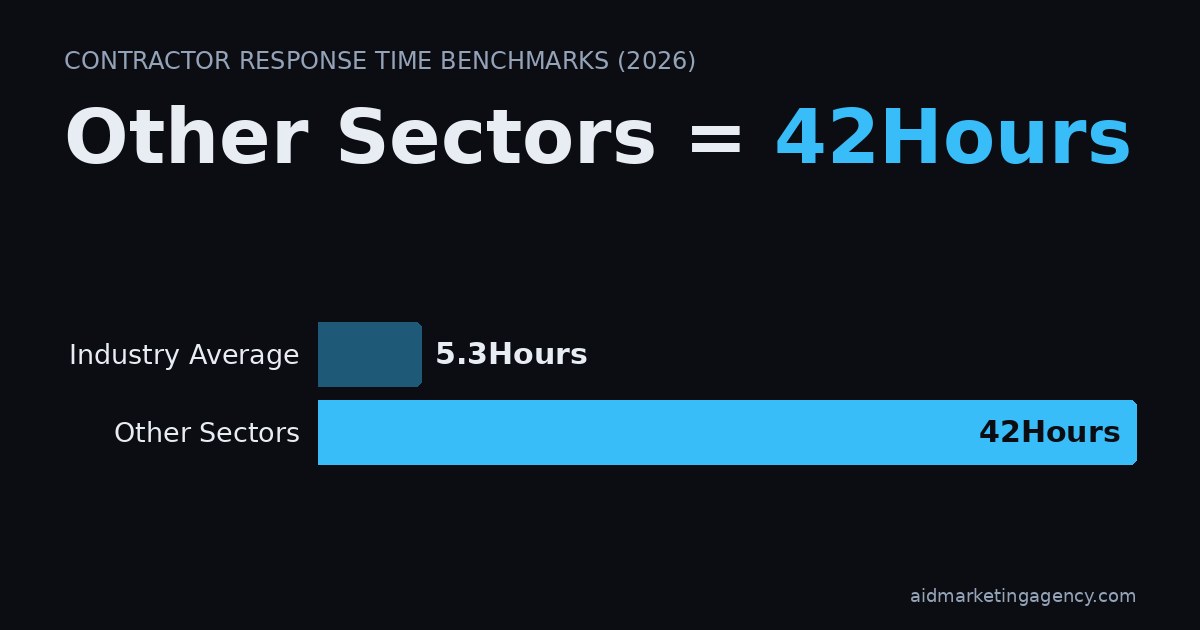
If you feel like you are struggling to keep up, you are not alone. Research into home service benchmarks by ServiceTitan (2026) indicates that the average response time for many contractors sits at roughly 5.3 hours. Only about 7 percent of companies manage to respond within that critical 5-minute window.
This means that if you can simply automate your first response, you are already in the top tier of your local market. You do not need to be perfect. You just need to be faster than the other guys who are waiting until their lunch break to check their emails.
The 'Roof-Ready' Playbook: How to Automate Speed-to-Lead
The goal of automation is not to replace you. It is to keep the conversation warm until you can step down from the ladder. When a lead hits your system, you need a tool that handles the "I got your message" part immediately.
Modern field-service platforms like ServiceTitan (2026) have built-in features that allow for personalized SMS responses the moment a lead is captured. You are not sending a robot to sell your services. You are sending a digital handshake that says: "I see you, I am on a job, and I will call you at 4:00 PM." That simple acknowledgement keeps the homeowner from calling the next three contractors on their list.
Step-by-Step: Setting Up Your Instant-Response Workflow
- Centralize your lead intake: Ensure every form, call, and social media message lands in one dashboard.
- Deploy an instant SMS trigger: Set up an automated text that goes out the second a lead comes in. Keep it human.
- Set your callback window: Use your automated message to set a clear expectation. If you tell them you will call at 4:00 PM, you must call at 4:00 PM.
- Qualify on the fly: Use a simple digital intake form to get the details you need before you even pick up the phone.
Beyond the Auto-Reply: Transitioning from Automation to Human Connection
Automation is the bridge, but you are the destination. The auto-reply is just a way to buy yourself time. When you do call that homeowner back, you already have the advantage. You are not a stranger calling out of the blue. You are the professional who respected their time enough to acknowledge them immediately.
For more on how we handle these systems, check out our About Ryan page, our guide on Charlotte lead management, or our national overview on contractor lead conversion.
FAQ
What are the current speed-to-lead statistics for 2026? Current benchmarks from ServiceTitan (2026) show that the average response time for home services is roughly 5.3 hours, while only about 7 percent of businesses manage to respond within the 5-minute gold standard.
Why is a 5-minute response time considered the gold standard for contractors? Foundational research suggests that responding within 5 minutes can increase qualification odds by 21x compared to waiting 30 minutes, as it captures the customer while they are still actively seeking a solution (Lead Response Management, 2007).
How can I respond to leads instantly if I am working on a roof or in a crawlspace? You can use automated SMS triggers that acknowledge the lead and set a specific time for you to call them back, ensuring the customer feels heard without requiring you to stop your work (ServiceTitan, 2026).
Does speed-to-lead really matter more than increasing my marketing budget? In our experience, lead latency is a larger bottleneck than lead volume. Increasing your ad spend only brings in more leads to ignore, whereas improving your response speed maximizes the value of the leads you are already paying for.
Ryan McNally Founder, AID Marketing Agency About Ryan