AI Marketing Agency in Charlotte: The 2026 Playbook for Contractors
Stop chasing AI content trends. For Charlotte contractors, the real ROI in 2026 comes from using AI to automate lead routing, slash admin time, and win the speed-to-lead race. Here is how to build a systems-first approach that actually moves the needle.

If you are running a service business in Charlotte, you have likely heard the pitch: AI will write your blogs, run your social media, and magically fill your pipeline. Most of that is noise. In 2026, the contractors who are actually winning are not the ones flooding the internet with AI-generated posts. They are the ones using AI to fix the broken parts of their operations that lose money every single day.
ServiceTitan's 2026 AI report found that 38 percent of contractors now report measurable business impact from AI, up from just 17 percent in 2025 (ServiceTitan, 2026). The gap between the winners and the rest of the market is widening, but the winning strategy is not about content. It is about efficiency.
For the full national picture, see the AI marketing for contractors playbook. This Charlotte-focused guide zooms in on what works specifically for shops competing in this market.
The State of AI in the Trades: Why 2026 is the Year of Efficiency
For years, the trade industry viewed AI as a futuristic concept. That era is over. Today, it is a tool for survival. A recent survey of 1,032 contractors across seven trades showed that 46 percent of shops are already using or experimenting with AI, and 74 percent believe it has strong potential to drive efficiency (ServiceTitan, 2025; ServiceTitan, 2026).
The shift is clear. Contractors are moving away from "AI as a toy" and toward "AI as a teammate." When you look at the Charlotte market, the competition for skilled labor and high-value leads is intense. If your shop is still manually typing up quotes, chasing down missed calls, or struggling to route leads to the right technician, you are leaking revenue.
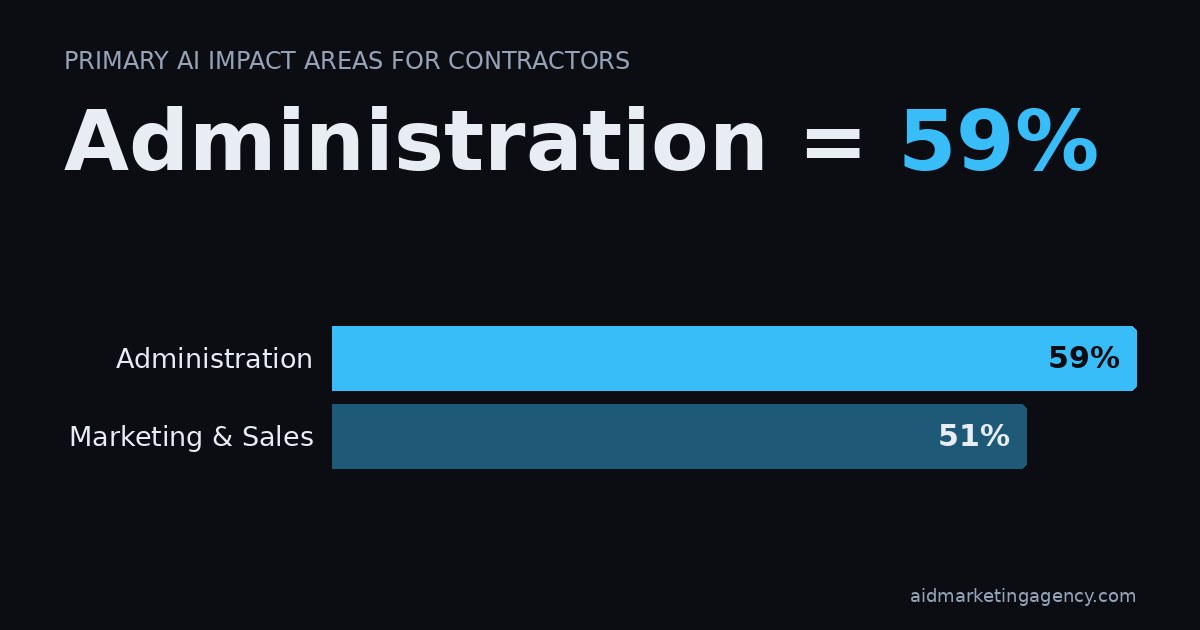
The data confirms that the biggest impact is not in creative marketing, but in the boring, necessary work of running a business. ServiceTitan's 2025 research of over 1,000 contractors revealed that AI's primary impact is in administration at 59 percent, followed by marketing and sales at 51 percent (ServiceTitan, 2025). If you want to grow, you start by automating the back office.
This lines up with what the national AI marketing for contractors data shows across the country: the shops getting real returns are investing in operational systems, not content factories. Charlotte is no exception. The contractors winning here are the ones who treat their CRM and dispatch software as marketing infrastructure, not just back-office tools.
The 38 percent of contractors reporting measurable AI impact in 2026 is more than double the 17 percent from 2025 (ServiceTitan, 2026). That jump signals a tipping point. The early adopters have moved past experimentation into real implementation, and they are pulling ahead of competitors who are still deliberating. For Charlotte shops, the window to get in early enough to matter is still open, but it is narrowing fast.
Beyond Content: Why Admin Automation is Your Marketing Secret Weapon
Marketing is not just about getting the phone to ring. It is about what happens once the phone rings. If your marketing is perfect but your front-office operations are slow, your cost per acquisition will skyrocket.
Think about your current workflow. When a lead comes in from a search query in Charlotte, how long does it take to get a quote in their hands? If it takes more than a few minutes, you are already losing ground. Older research suggests the odds of contacting a lead drop dramatically with response time. The 2007 MIT-affiliated Lead Response Management Study found that the odds of contacting a lead drop by 100 times if you wait 30 minutes instead of five minutes (Oldroyd, 2007). That figure is from a single older study and should be treated as directional rather than definitive. What recent data does corroborate is the broader principle: speed-to-lead matters. ServiceTitan's 2025 and 2026 contractor surveys both identify speed-to-lead as a primary efficiency driver, with 74 percent of contractors citing AI's potential to improve response times and operational throughput (ServiceTitan, 2026).
Harvard Business Review's analysis of lead response data (HBR, 2013) reinforces why this matters: the window to reach a lead is narrow, and it closes fast. The first contractor to respond usually wins the job, not the one with the best SEO or the most polished blog.
By using AI to automate the administrative side of marketing, you accomplish three things:
- You free up your staff to focus on high-value customer interactions instead of manual data entry.
- You eliminate the human error that leads to missed follow-ups and dropped leads.
- You ensure that every lead is qualified and routed to the right person immediately, before the prospect calls the next shop on the list.
When you treat your admin automation as a marketing expense, you stop viewing it as overhead and start viewing it as a growth engine. For a deeper dive on one specific tactic, the missed-call text-back guide for contractors breaks down how automated responses keep leads warm before a human ever picks up the phone.
The connection between admin speed and marketing ROI is the piece most agencies miss. They sell content and rankings. But if your shop takes four hours to return a call, no amount of blog traffic will fix the conversion problem. The contractors who understand this are the ones building systems that make speed automatic, not optional.
The Speed-to-Lead Playbook: How AI Wins Jobs in the Charlotte Market
In Charlotte, homeowners and property managers have options. They are scrolling through Google, calling the first three names they see, and booking the first shop that answers the phone or provides a clear, fast quote.

The speed-to-lead race is won by the shop that eliminates friction. AI can handle the initial intake, verify the lead, and even provide an estimated price range before a human ever touches the file. This does not replace your team. It gives them a head start.
When you implement an automated lead-response system, you are not just being faster. You are being more reliable. A common pattern in high-performing shops is the use of automated text-back systems that engage the customer the moment they reach out. This keeps them from calling the next competitor on the list. By the time your office manager sits down to handle the lead, the customer already feels heard and prioritized.
Recent call-intelligence research from Invoca (2024) reinforces that response speed remains a primary conversion driver for inbound service calls. When a homeowner calls a plumber, roofer, or HVAC tech, the shop that picks up or texts back first usually gets the job. The technology to make that happen is already inside most field-service platforms. You do not need to build it from scratch.
The key is to map your response workflow before you buy anything. Write down every step from the moment a lead comes in to the moment a quote goes out. Count the handoffs. Count the delays. That map is your AI roadmap. Every delay you find is a place where a competitor can slip in and steal the job.
Here is what a tight speed-to-lead workflow looks like in a Charlotte service shop:
- Inbound call or form submission arrives. An automated system logs it instantly, no manual entry required.
- Instant text or email confirmation. The customer gets a response within seconds, not hours. Even a simple "we received your request and will call you shortly" keeps them from dialing the next number.
- Lead routing. The system assigns the lead to the right technician or sales rep based on geography, trade, or availability. No dispatcher has to hunt for the right person.
- Quote generation. If your platform supports it, an automated estimate goes out before the first human conversation. Even a ballpark range gives the customer something to anchor on.
- Human follow-up. Your team calls back with context, not cold. They know what the customer asked for, when they asked, and what the automated system already told them.
Each step removes a few minutes of friction. Stacked together, those minutes are the difference between winning the job and never knowing it existed.
The Multi-Family Turn Cycle: A Worked Example of Speed-to-Lead in Action
This is where Charlotte's market gets specific. The single most overlooked application of speed-to-lead in this city is not in residential service calls. It is in the multi-family turn cycle.
Worked example (illustrative, not a client result): Consider a 200-unit apartment community in Charlotte turning 40 units per quarter. Each unit turn requires multiple trades overlapping: paint, flooring, appliances, punch-out work. Flooring is one of the last trades in. If the flooring vendor takes 24 hours to return a quote, the property manager cannot lock the install date. That cascades. The next trade gets pushed. The turn slips. The lease-up gets delayed.
At even one day of delay per turn across 40 units in a quarter, the portfolio bleeds occupancy time. Now compare that to a vendor with a system that returns quotes in under ten minutes. The property manager locks the date the same day. The turn stays on schedule. The difference is not ten minutes of time saved. It is an entire day of occupancy per unit, multiplied across the portfolio.
This is why speed-to-lead is not a marketing concept in the multi-family world. It is an operational necessity. Property managers running turns do not have time to chase three flooring vendors for pricing. When one vendor's system gets a quote back in minutes instead of hours, that vendor gets the work order. When the quote drags, the property manager calls the next name on the list.
The same logic applies to any trade in the turn cycle: HVAC replacements between tenants, plumbing rough-ins, paint scheduling. The vendor who responds fastest and most reliably earns the repeat business. AI tools that automate quote generation, missed-call text-back, and lead routing are not nice-to-haves in this environment. They are the difference between being the vendor a property manager calls first and the one they call when the first choice does not deliver.
In many shops, the first step is simple: a missed-call text-back system that catches the leads that slip through when the office is on another call. That one change can recover jobs that would otherwise go to a competitor without anyone knowing they were lost. The property manager does not call back to see if you were available. They call the next vendor, and that vendor gets the work order.
The multi-family turn cycle also reveals why "AI marketing" is a misleading label for what actually drives growth here. The flooring vendor who wins the repeat contract is not winning because of better blog content or more Facebook posts. They are winning because their quote system is faster, their missed calls get answered automatically, and their routing gets the right installer scheduled the same day. That is operational infrastructure doing marketing's job. When the operations are tight, the marketing just needs to get the phone to ring once. The system handles the rest.
Choosing Your Tech Stack: Why Embedded AI Beats Point Solutions
One of the biggest mistakes contractors make is buying a dozen different "AI tools" that do not talk to each other. You end up with a fragmented tech stack that creates more work than it saves.

The best approach is to leverage the AI features already embedded in the software you use every day. ServiceTitan's 2026 AI guide highlights that contractors generally prefer integrated features over standalone point solutions (ServiceTitan, 2026). If your field-service platform already has AI-powered call analysis or automated dispatching, start there.
Adding a new, disconnected tool adds complexity. Using what you already have and pushing it to its full potential adds value. Before you sign up for a new AI platform, ask yourself if your current software provider already has a solution that does 80 percent of the job. Usually, the answer is yes.
Here is a simple framework for evaluating whether to add a new tool or use what you have:
| Question | If Yes | If No |
|---|---|---|
| Does your current platform have AI features you are not using? | Turn those on first | Move to the next question |
| Do your tools integrate cleanly with each other? | Consider a targeted add-on | You have a stack problem, not a tool problem |
| Is the new tool solving a problem your current stack cannot solve? | Evaluate it carefully | You do not need it |
The contractors seeing the best results in 2026 are not running ten AI tools. They are running one or two platforms well, with AI features turned on and configured to handle the repetitive work that eats up a dispatcher's day. The goal is fewer logins, fewer integrations to maintain, and fewer places for data to get lost.
When a shop does need a standalone tool, it is usually to fill one specific gap that the main platform does not cover. A missed-call text-back system is a good example. If your field-service platform does not have that feature built in, a single, focused tool that does nothing else can be worth it. But that tool should feed data back into your main CRM, not operate in a silo.
How to Audit Your Current Marketing Operations for AI Readiness
Before you spend a dime on new AI tools, you need to know where your leaks are. Use this simple audit to see if your shop is ready for a systems-first approach:
-
The Response Test: How long does it take for a lead to get a response after they fill out a form or call? If it is over 10 minutes, your priority is speed, not content. Call your own office from a different phone and time it. Then fill out your own web form and see what happens. The results may surprise you.
-
The Data Check: Is your customer data clean? AI is only as good as the data it is fed. If your CRM is a mess with duplicate entries, missing phone numbers, and old leads clogging the pipeline, AI will just automate your mistakes. Clean the data first, then layer in automation.
-
The Admin Bottleneck: What is the one task your team complains about most? If it is manual data entry, scheduling, or follow-up calls, that is your first target for automation. Do not try to automate everything at once. Pick the single biggest bottleneck and solve it.
-
The Missed Call Audit: Pull your phone logs for the last 30 days. How many inbound calls went unanswered during business hours? Each one of those is a lost job. If the number is higher than you expected, a missed-call text-back system is your highest-ROI first move.
-
The Quote Speed Test: Time how long it takes to turn a request into a quote. If your team is still manually building quotes from scratch, there is a massive opportunity to standardize and automate. Even a template library with AI-assisted population can cut quote time from hours to minutes.
If you find that you are spending more time managing your software than managing your business, it is time to simplify. Focus on the systems that move the needle, and leave the content hype to agencies that do not understand how a real contracting business works.
Building Your AI Implementation Roadmap
Once you have audited your operations, the next step is building a roadmap that prioritizes impact over novelty. Here is a phased approach that works for most Charlotte service businesses:

Phase 1: Response Speed (Weeks 1 to 4) Start with the lowest-hanging fruit. Turn on missed-call text-back. Set up automated email and text responses for web form submissions. Configure your CRM to send an instant confirmation to every lead, even if it is just a "we got your message and will call you back shortly." This phase does not require any new tools. It requires configuring what you already have.
Phase 2: Admin Automation (Weeks 5 to 12) Identify the two most time-consuming administrative tasks in your shop. These are usually data entry, scheduling, or follow-up reminders. Work with your existing platform to automate as much of those tasks as possible. If your field-service software has AI-powered scheduling or dispatch suggestions, test them on a small batch of jobs first.
Phase 3: Lead Intelligence (Months 4 to 6) Once the basics are running, layer in AI tools that help you understand which leads are worth chasing. Call analysis tools can score leads based on the conversation. Automated lead routing can send high-value jobs to your best technicians. This is where efficiency compounds: faster response plus better routing means higher close rates with less wasted effort.
Phase 4: Marketing Optimization (Month 6 and beyond) Only after your operations are running smoothly should you turn to AI for marketing content. Use it to analyze which campaigns are driving the best leads, not to mass-produce blog posts. The goal is to feed your now-efficient operation with better-qualified leads, not to flood a broken system with more volume.
For shops looking at the full speed-to-lead playbook for home services, the sequence matters. Speed first, intelligence second, content last.
Common Pitfalls When Adopting AI in a Service Business
Not every AI implementation goes smoothly. Here are the most common mistakes contractors make and how to avoid them:
Buying before auditing. Too many shops buy an AI tool because they saw a demo at a trade show, then try to find a use for it. Reverse the order. Find the bottleneck, then find the tool that solves it.
Automating a broken process. If your lead intake process is messy, automating it just makes the mess happen faster. Fix the workflow first, then automate it. A clean, manual process is always better than an automated chaotic one.
Overestimating what AI can do. AI in 2026 is powerful, but it is not magic. It cannot fix a pricing problem, a bad technician, or a reputation issue. It handles repetitive, rules-based tasks. It does not replace strategy, judgment, or relationships.
Neglecting the human follow-up. Automated responses buy you time, but they do not close the deal. If your automated system sends a text and then nobody calls the lead back, you have not improved anything. The automation is a bridge to a human, not a replacement for one.
Ignoring data hygiene. AI needs clean data to work. If your customer records are full of duplicates, wrong numbers, and outdated information, every automated workflow will produce garbage. Spend a weekend cleaning your CRM before you turn on any AI features.