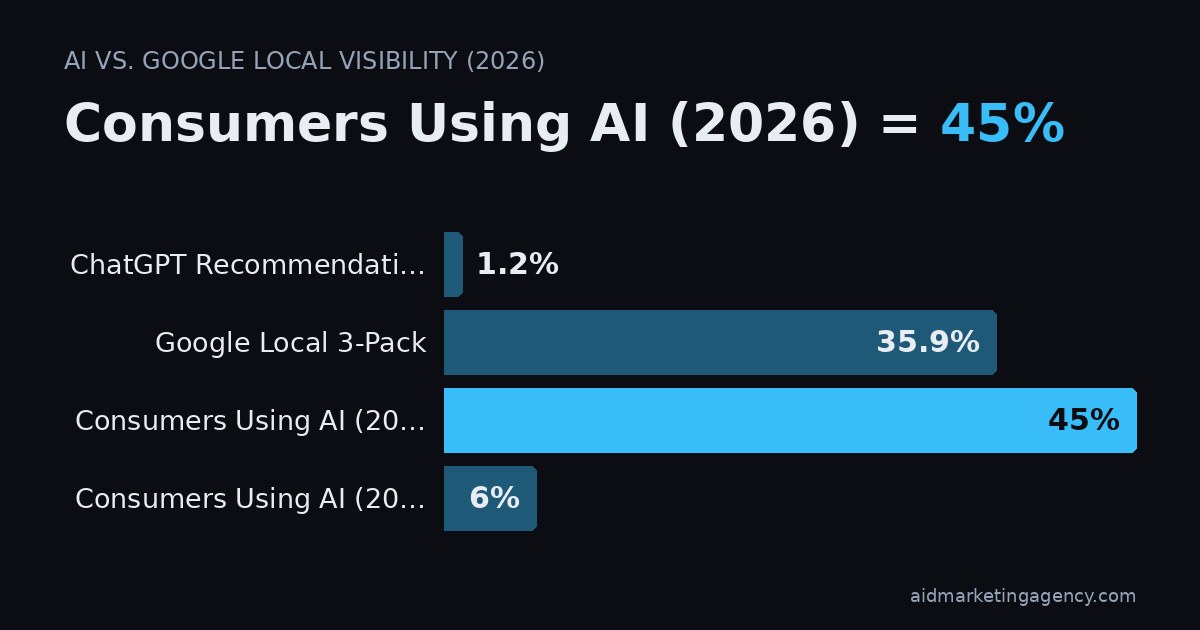
Only 1.2% of local business locations get recommended by ChatGPT, compared with 35.9% that show up in Google's local 3-pack, according to SOCi's 2026 Local Visibility Index, which looked at nearly 350,000 locations across 2,751 multi-location brands (National Law Review, 2026). If that number surprised you, you're not alone. Most business owners assume that showing up well on Google means they're also showing up well in ChatGPT, Gemini, or Perplexity. That assumption is wrong, and the gap between the two is bigger than most contractors realize.
ChatGPT isn't running a search engine ranking algorithm. It's synthesizing a short answer from a small pool of sources it trusts enough to cite. That's a different game with different rules, and this post walks through how to test where you stand, what actually seems to move the needle, and a repeatable script you can run every month to track it.
The Real Numbers: How Rare It Is to Be "Recommended" by ChatGPT in 2026
Let's sit with that 1.2% figure for a second, because it's the whole story. SOCi's 2026 Local Visibility Index analyzed almost 350,000 locations belonging to 2,751 multi-location brands, and found that just 1.2% of those locations were surfaced when ChatGPT was asked for local recommendations (National Law Review, 2026). In the same reporting on that index, 83% of restaurants didn't appear in AI-generated local recommendations at all (National Law Review, 2026).
Read that again: not "ranked lower." Absent. For most categories, AI search isn't handing out a page-two spot the way Google does. It's either mentioning you or it isn't.
If you run a roofing company, an HVAC business, or any local-service shop, that 1.2% number should reframe how you think about AI visibility. This isn't a ranking factor you nudge with a few tweaks. It's closer to a gate, and most businesses are on the wrong side of it without knowing.
ChatGPT vs. Google Local: Why 1.2% vs. 35.9% Isn't an Apples-to-Apples Comparison
Google's local 3-pack gives visibility to roughly 35.9% of businesses in a given category search, per the same 2026 coverage of the SOCi index (National Law Review, 2026). That's still competitive, but it's a completely different shape than ChatGPT's 1.2%.
Here's the plain-English version. Google's local pack is built to show a spread: three businesses, then a full list below the fold, then page two. It's designed to give lots of businesses at least a chance at visibility. ChatGPT (and Gemini and Perplexity, which work similarly) is designed to give a short, confident answer. That means it behaves more like a winner-take-most system than a directory.
Think of it like the difference between a phone book and a friend giving you a recommendation. The phone book lists everyone. The friend names one or two places they actually trust. AI search is acting like the friend, not the phone book, and that changes what "visibility" even means.
| Google Local 3-Pack | ChatGPT Local Recommendations | |
|---|---|---|
| Share of businesses appearing | 35.9% (National Law Review, 2026) | 1.2% (National Law Review, 2026) |
| Format | Ranked list, expandable | Short synthesized answer, usually 1 to 3 names |
| Failure mode | Lower ranking, still visible on page | Complete absence from the answer |
If you want the fuller mechanics of how these engines decide what to surface at all, we cover that in our breakdown of how generative engine optimization actually works.
Why 45% of Consumers Now Ask AI for Local Recommendations (Up From 6%)
Here's the part that makes the 1.2% number urgent instead of just interesting. Cheers reports that 45% of consumers used AI tools like ChatGPT, Gemini, or Perplexity to find local business recommendations in the past year, up from 6% in 2025 (Cheers, 2026).
That's not a slow trend. That's a behavior shift happening in real time, and it's happening while most local businesses have no idea whether they're one of the 1.2% getting mentioned or one of the 98.8% that aren't. In our experience across the clients we run, most owners have never even run the test to check.
If nearly half of your potential customers are now asking an AI tool "who should I call for X near me," and your business isn't one of the names it gives back, you're not losing a ranking spot. You're losing the conversation entirely, before the customer ever opens Google. That's a different problem than classic local SEO, and it's worth understanding how local SEO and AI visibility diverge before you spend a budget assuming they're the same fix.
Step 1: Run the Direct Test, Query ChatGPT, Gemini, and Perplexity Yourself
You don't need a tool subscription to find out where you stand. You need ten minutes and a consistent script.
Open ChatGPT, Gemini, and Perplexity in separate tabs and ask each one the kind of question a real customer would type. Not "tell me about [Business Name]." That's not how people search. Ask it the way a homeowner or property manager actually would:
- "Who's a good roofer near [your city]?"
- "Best HVAC company in [your city] for an emergency repair?"
- "I need a flooring contractor in [your city], who should I call?"
Log whether your business shows up, in what position, and whether it shows up at all. Do this across all three tools, because they don't pull from identical sources and don't agree with each other nearly as often as people assume.
Step 2: Decode Which Sources the AI Cites (And What That Tells You)
When ChatGPT or Perplexity does recommend a business, it usually shows its work, either with inline citations or a "sources" section. Read those. They're the single best clue you'll get about how that answer got built.
If your competitor gets cited and the source is their Google Business Profile, that tells you something different than if the source is a local news article or a review aggregator. The pattern usually points to the same handful of source types: business listing platforms, review sites, and occasionally local press or industry directories.
This is diagnostic work, not guesswork. If you never see your own website cited anywhere across a dozen test queries, that's a signal your site isn't structured in a way these tools can confidently pull from, and that's worth fixing before anything else.
Step 3: Audit the Machine-Readable Signals AI Tools Actually Rely On
AI tools can't call your office to confirm your hours or your service area. They rely on what's already published and structured clearly enough to trust. In our experience running these tests across contractor clients, the businesses that get cited most consistently tend to have the same few things in common: consistent business information across every listing, structured data that names their business type and service area, and clear service details published in plain text rather than buried in a slider image or a PDF.
Worth being straight with you here: the exact weighting these tools use isn't publicly disclosed, and a lot of what gets written about "how ChatGPT ranks businesses" is educated guessing, not a leaked algorithm. Treat any claim that sounds too specific with some skepticism, and treat the general direction, clarity and consistency matter, as the safe bet.
A quick audit checklist:
- Does your homepage state your service area and services in plain sentences, not just a logo and a slider image?
- Do you have schema markup identifying your business type, address, and service area?
- Is your NAP (name, address, phone) identical across your website, Google Business Profile, and major directories?
Step 4: Fix Consistency Gaps Across Your Website, GBP, and Listings
This is the least glamorous step and the one most businesses skip. If your Google Business Profile says "Charlotte Roofing Co." and your website footer says "Charlotte Roofing Company LLC," and a directory listing says "Charlotte Roofers," that's three different entities to a machine trying to verify who you are.
Pull up your Google Business Profile, your website, and your top three directory listings side by side. Match the business name, address, phone number, and hours exactly across all of them. Then check that your service area is stated the same way everywhere, not "Charlotte and surrounding areas" in one place and a list of seventeen zip codes in another.
None of this is exciting work. It's also exactly the kind of unglamorous cleanup that separates the businesses AI tools can confidently cite from the ones they quietly skip.
Step 5: Build Review Volume and Authority Signals That Support Citation
Reviews aren't just for humans deciding whether to trust you. They're one of the clearest signals a machine can point to when it's building a short, defensible answer. A business with a steady flow of recent reviews across Google and a couple of other platforms is easier for an AI tool to point to with confidence than one with a handful of reviews from three years ago.
Authority signals extend beyond reviews too: mentions in local press, listings in industry-specific directories, and any third-party validation that isn't just your own marketing. In our experience across the clients we run, businesses with a steady review cadence and a presence on more than one platform tend to show up more consistently when we run these AI visibility tests, though we're not aware of a published study that quantifies that exact relationship, so treat it as a pattern we've observed rather than a hard rule.
Step 6: Re-Test on a Schedule and Track Changes Over Time
AI search results shift. The models get updated, the sources they trust change, and your own fixes take time to show up. A one-time check tells you where you stand today. A repeated check tells you whether what you're doing is working.
One contractor client we work with, a residential roofing company in a mid-size Southeastern market, ran the exact test script above across all three tools in early 2026 and showed up in zero of nine queries, despite sitting on page one of Google for nearly every one of those same searches. Over the following month they cleaned up NAP mismatches between their GBP, website, and two directory listings, and added service-area schema to their homepage. When they re-ran the same nine queries a month later, they appeared in two of them, both times cited off their Google Business Profile. That's a small sample from one business, not a controlled study, but it's a real before-and-after and it matches the pattern we see elsewhere: consistency fixes move the needle faster than content volume does.
Here's a simple log you can copy into a spreadsheet and run once a month.
AI Visibility Test Log
Prompts to run every month, adjusted for your city and trade:
- "Who's a good [your trade] near [your city]?"
- "Best [your trade] company in [your city] for [common job type]?"
- "I need a [your trade] in [your city], who should I call?"
Log format:
| Date | Tool | Prompt | Did we appear? (Y/N) | Position (if listed) | Sources cited in the answer |
|---|---|---|---|---|---|
| ChatGPT | |||||
| Gemini | |||||
| Perplexity |
Run it monthly, keep the log in one place, and watch the "sources cited" column closely. When you see a new source type showing up across multiple tools, that's usually your next fix, not a coincidence.
What Doesn't Work: Myths and Unverified "AI Hacks" to Avoid
There's a growing pile of content promising a secret trick to get ChatGPT to recommend your business. Most of it doesn't hold up.
There's no submission form. Unlike Google Business Profile, there's no dashboard where you claim your listing and tell ChatGPT you exist. Anyone selling you an "AI submission service" is selling you something that doesn't map to how these tools actually work.
Keyword stuffing doesn't transfer. Tactics built for ranking on Google, like packing your homepage with keyword variations, don't translate to AI synthesis the same way. These tools are reading for clarity and confirmation across sources, not counting keyword density.
Be careful with specific mechanism claims. You'll see confident statements online about exactly which data source ChatGPT weighs most heavily for local results. Some of those claims don't trace back to a credible primary study, so treat anything that specific as unverified until you can confirm it yourself.
A Realistic Playbook for Contractors and Local-Service Businesses
If you run a roofing, HVAC, flooring, or similar local-service business, here's the order of operations that actually matters:
- Run the direct test this week using the script above, across all three tools.
- Fix any NAP and service-area inconsistencies you find between your site, GBP, and directories.
- Make sure your website states your services and service area in plain, crawlable text.
- Build a steady review cadence rather than a one-time review push.
- Re-run the test monthly and watch which sources get cited.
None of this guarantees a spot in that 1.2%. What it does is put you in the pool of businesses that are eligible to be cited, which is a real improvement over not being eligible at all.
Ryan McNally is the founder of AID Marketing Agency and has spent over a decade running local-service sales and marketing operations before building AI-driven growth systems for contractors. More about Ryan.