GEO for Contractors: How to Get Cited When Homeowners Ask AI Who to Hire
As AI search tools become the primary discovery engine for 22% of homeowners (Scorpion, 2026), contractors must shift from traditional SEO to Generative Engine Optimization (GEO). By structuring business data to be easily cited by AI, you ensure your company is the one recommended when customers ask for local service providers. For the full framework on how AI search picks winners, see the guide to AI search recommendations for contractors.

Think of GEO like leaving a clean set of footprints on every job site you work. If those prints are muddy or half-wiped, nobody can trace them back to you. But if they are crisp and consistent across every site, anyone following the trail knows exactly who did the work. That is what GEO does for your digital presence: it makes your business data easy to find, easy to trust, and easy to quote.
The Shift: Why Homeowners Are Bypassing Traditional Search
The way homeowners find their next plumber, roofer, or HVAC tech is changing fast. For years, the path was simple: open a search engine, scan the map pack, and click a few websites. Today, that journey is being replaced by conversational AI. Homeowners are asking questions like, "Who is the best-rated HVAC company in Charlotte that offers emergency service?" and receiving a single, synthesized answer instead of a list of blue links.
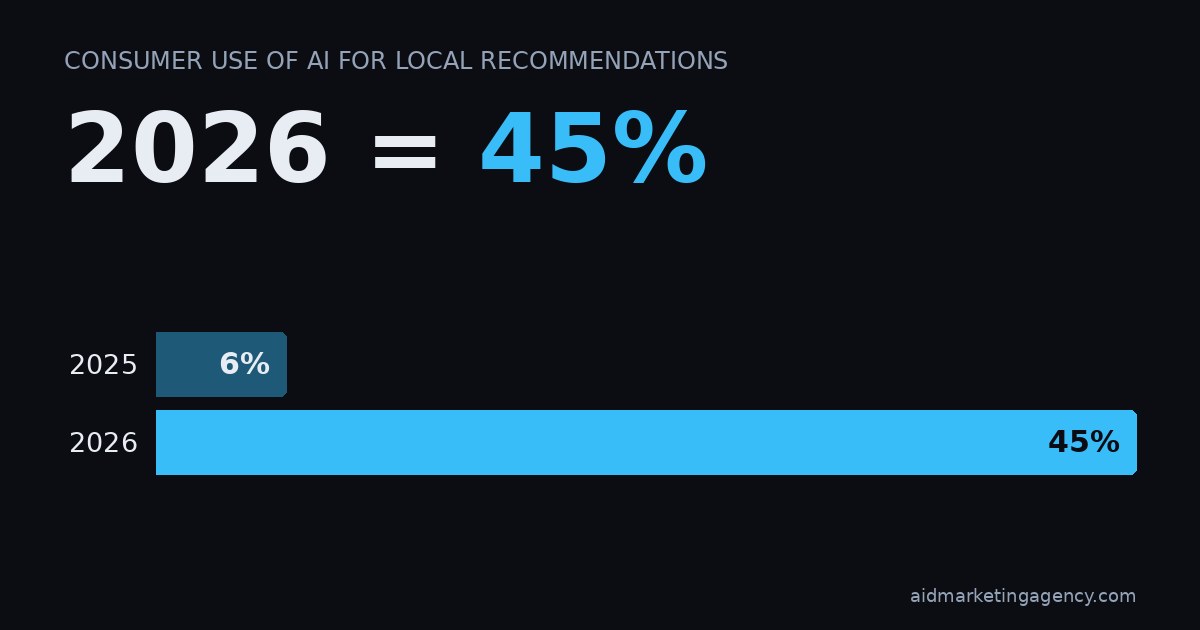
This behavior is not just a trend for tech enthusiasts. BrightLocal's 2026 Local Consumer Review Survey found that 45% of consumers used AI tools for local business recommendations in the past year, a massive jump from just 6% the year before. When nearly half of your potential customers start their search in a chat window rather than a search bar, your business needs to be the one the AI chooses to mention.
If you want to dig deeper into the foundation that makes these AI citations possible, check out the 5-minute audit to see what ChatGPT says about your business, which covers the baseline signals AI models rely on.
The New Reality: AI Overviews and the 68% Visibility Threshold
If you have noticed your website traffic shifting, you are not imagining it. AI Overviews, the summaries generated by search engines to answer user queries directly, are now a dominant force. According to the 2026 local search study by Whitespark, these AI Overviews appear on 68% of local business-type queries.

This means that for more than two-thirds of the searches relevant to your trade, the search engine is providing a curated answer before a user even scrolls to the organic results. If your business is not cited in that summary, you are effectively invisible to a large portion of your local market. Scorpion's 2026 national homeowner study confirms this shift, noting that 22% of homeowners now turn to AI tools first when researching service providers. The goal of GEO is to ensure your business data is the most reliable, accurate, and accessible information for these engines to process.
How AI Decides Which Contractor to Recommend
AI models do not "choose" a contractor based on gut feeling. They operate on a foundation of trust signals and data clarity. When an AI is asked to recommend a contractor, it scans its training data and real-time search index for businesses that meet three primary criteria:
- Relevance: Does your business explicitly state that you offer the specific service the homeowner is asking for? A page titled "Services" tells the AI nothing. A page titled "Emergency Water Heater Repair in Charlotte" tells it exactly what you do and where you do it.
- Authority: Are you mentioned in reputable third-party sources, such as local industry publications, verified review platforms, or community news? AI models treat these mentions as independent votes of confidence.
- Consistency: Is your name, address, and phone number (NAP) identical across every platform where your business appears? Even a small discrepancy, like "LLC" in one listing and "LLC." in another, can signal low reliability to an AI model.
If your website is vague or your business listings are inconsistent, the AI cannot confidently recommend you. It will default to the competitor who has provided the clearest, most verifiable data. Think of it like a homeowner comparing two bids: one is typed up with clear line items, and the other is scribbled on a napkin. The typed bid wins every time, even if the work quality is identical.
Tactical Playbook: Optimizing Your Business for AI Citations
To improve your chances of being cited, you must treat your digital presence as a database for AI to read. Follow these steps to make your shop the obvious choice:
- Create Service-Specific Pages: Do not just list your services on a single page. Build individual pages for each service, such as "Emergency Water Heater Repair" or "Residential Roof Replacement." Use clear, descriptive headings that answer the questions homeowners actually ask. Each page should state the service, the service area, and a direct answer to the most common hiring question for that trade.
- Standardize Your Business Data: Ensure your business name, address, and phone number are perfectly consistent on your website, Google Business Profile, and every directory you use. AI models flag discrepancies as a sign of low trust. For a deeper dive into managing your online presence, see the AI speed-to-lead playbook for contractors, which covers how to keep your business data working for you across channels.
- Generate High-Quality Reviews: AI systems rely on the sentiment and volume of reviews to gauge reputation. Focus on getting detailed reviews that mention specific services or project types, as this provides the AI with proof of your expertise. A review that says "Great company" is nice. A review that says "They replaced our roof in two days and cleaned up every nail" gives the AI something specific to cite.
- Answer Hiring Questions Directly: Use a FAQ section on your website to address common concerns like licensing, insurance, typical response times, and service areas. When you provide a clear, concise answer, you make it easy for an AI to quote your site as the definitive source.
The Interception Gap: What the Data Reveals
Here is where the three cited studies, read together, expose something that no single report states directly.
Whitespark found that AI Overviews appear on 68% of local business queries in 2026. BrightLocal found that 45% of consumers used AI tools for local recommendations in the past year. But Scorpion found that only 22% of homeowners start their search with an AI tool. Put those numbers side by side and a structural gap appears: the majority of homeowners still begin in a traditional search bar, yet 68% of the local business queries they type surface an AI Overview before they ever reach the organic results.
That means a contractor who invests only in traditional SEO is paying for visibility that gets intercepted by an AI summary they are not cited in. The homeowner types "roof repair near me," sees an AI-generated answer at the top of the page, and never scrolls down to the blue links. The organic ranking still exists. It just sits below a summary that names a competitor instead.
A common pattern in many shops: a roofing company ranks organically at position two for "roof repair near me" in their market. Their Google Business Profile is complete, their reviews are strong, and their site loads fast. But when a homeowner types that same query and an AI Overview appears at the top of the page, the summary names a different roofer, one with more specific service pages and more consistent NAP data across directories. The first roofer's organic ranking still holds. It just sits below a summary that named someone else. The click goes to whoever the AI cited, not whoever ranked second organically.
The pattern repeats across trades. The contractor who gets cited is not necessarily the one with the most reviews or the longest-tenured domain. It is the one whose service pages, business categories, and review content use the exact phrasing homeowners type into a chat window. A roofer with a page titled "roof leak repair" gets cited for leak questions. A roofer with a page titled "roofing services" does not. The AI is not judging craft. It is matching language.
This interception gap is the core problem GEO solves. Traditional SEO gets you ranked. GEO gets you cited inside the summary that intercepts the ranking. A shop that appears at position one organically but is absent from the AI Overview above it is still losing the click to whoever the AI named first.
The practical takeaway: if your business data is not structured for AI readability, your organic ranking investment is being partially neutralized by a summary layer you are not participating in. Closing that gap means making your business data the easiest version for the AI to parse, trust, and quote.
Beyond the Website: Building Trust Signals for AI Models
Your website is the hub, but your reputation across the web is the engine. AI models look for third-party validation to confirm that your business is legitimate and active. A common pattern is that contractors who maintain active profiles on trusted industry platforms gain a meaningful advantage in citation frequency. Keep your profiles updated with current photos of recent work, accurate hours of operation, and responses to customer feedback. When an AI sees that you are active and engaged across multiple platforms, it increases the likelihood that it will select your business as a recommendation.
The same principle applies to local directories and industry associations. If your local home builders association lists you as a member, that is a trust signal. If your Chamber of Commerce profile is current, that is a trust signal. Every consistent, verifiable mention of your business across the web makes it easier for an AI to confidently cite you.
For a related angle on how speed and responsiveness factor into the homeowner's decision after the AI points them your way, see the 5-minute rule for speed-to-lead.