
In 2026, the contractors getting the most out of AI are not the ones chasing every shiny tool. They are the ones automating administrative intake and speed-to-lead first, while keeping AI away from high-stakes customer promises and unverified marketing copy. The stack that works is simple: handle the repetitive stuff, speed up the response, and keep a human eyeball on anything that touches a customer commitment.
The State of AI in the Trades: 2026 Benchmarks
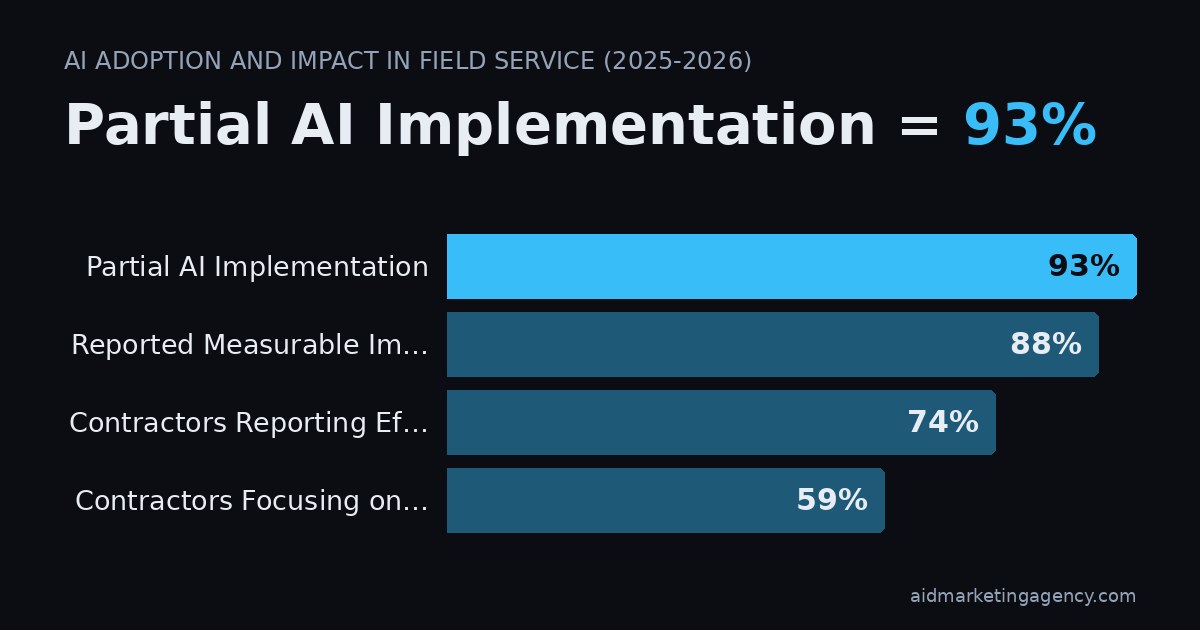
AI has moved past the hype phase and into the operational trenches. According to Geotab (2025), 93 percent of field service organizations have now partially implemented AI, with 88 percent reporting measurable improvements to uptime, costs, and the overall customer experience.
The data suggests that the most effective shops are not trying to replace their entire workforce with bots. They are using AI to handle the friction points that keep owners up at night: missed calls, scheduling bottlenecks, and repetitive data entry. ServiceTitan (2026) found that 74 percent of contractors using AI report increased efficiency and productivity, proving that the tech is already delivering real-world results for those who deploy it correctly.
Think of it like a jobsite. You do not hand the new guy the most delicate finish work on day one. You start him on demolition and cleanup, the stuff that is hard to mess up. AI works the same way. Put it on the low-risk, high-volume tasks first, and let your experienced people handle the finish work. The shops winning right now are the ones treating AI like a green helper who never gets tired, not like a foreman who never gets questioned.
Phase 1: Automate Your Back Office and Intake
If you want the highest return on your first AI investment, start with your back office. Administrative intake is currently the most common use case for AI in the trades, with 59 percent of contractors focusing their efforts here (ServiceTitan, 2026).

Why start here? Because administrative tasks are repetitive, predictable, and low-risk. When you use AI to transcribe calls, log customer details into your CRM, or categorize incoming service requests, you remove the manual labor that slows down your dispatchers. ServiceTitan (2026) also noted that 59 percent of adopters prefer AI features that are embedded directly into their existing field service software. This is the path of least resistance: use the tools you already pay for before you go shopping for new ones.
A common pattern in shops that move fast is the intake bottleneck. A dispatcher is juggling inbound calls, entering data, and trying to schedule techs all at once. Something drops. The call goes to voicemail, the data entry gets rushed, or the scheduling slips. AI intake tools catch the call, log the details, and queue the lead for a human to confirm. The dispatcher is still in control, but the robot is doing the typing.
Worked Example: What an Intake Bottleneck Costs
This is an illustration, not a client result. Say a two-truck shop gets 40 inbound calls a week. The dispatcher misses about 8 of those during peak hours. If the average job runs $400 to $600, and even half of those missed calls would have booked, that is $1,600 to $2,400 a week walking out the door. Over a year, that is $83,000 to $125,000 in lost revenue from a single bottleneck. Automating intake does not fix every missed call, but it catches the ones that slip through during the lunch rush or the afternoon push. The math is not fancy. It is just the cost of the gap, stated plainly.
Phase 2: Accelerate Lead Response and Scheduling
Once your intake is stable, the next logical step is speed-to-lead. Older research suggests that the speed at which a shop responds to a new inquiry is one of the strongest predictors of whether that lead actually books a job. While those older studies provide a baseline, recent industry patterns corroborate the same principle: response delays are a primary cause of lead leakage.

For a deeper dive on this, check out The 5-Minute Rule: Why Speed-to-Lead Beats Marketing Spend. The short version: the first shop to answer wins more often than the shop with the best marketing budget.
Your goal in Phase 2 is to ensure that no prospect is left waiting for a callback. By automating the initial response to web leads or after-hours inquiries, you keep the prospect engaged until a human can take over. This is not about replacing the human touch: it is about ensuring that your team is talking to a warm lead rather than chasing a cold one.
A missed call is not just a missed conversation. It is a missed estimate, a missed install, and a missed referral down the road. For the math on what that actually costs a roofer in 2026, see What a Missed Call Actually Costs a Roofer in 2026.
If you want the full playbook on how to wire AI into your lead response, AI Speed-to-Lead for Contractors: The 2026 Playbook breaks it down step by step. And if you want to know who called before you pick up the phone, Lead Enrichment for Trades covers how to surface caller details before the first ringback.
Phase 3: Marketing Assistance (With Human Oversight)
Marketing is the third pillar of your AI stack. AI is excellent at drafting email sequences, social media captions, or blog outlines, but it needs a human hand on the wheel.

Use AI to generate the first draft of your content, but never hit publish without a review. Every piece of copy needs to align with your brand voice and, more importantly, it should not make promises your team cannot keep. AI can help you scale your marketing output, but it cannot replace the local expertise that makes your business the preferred choice in your neighborhood.
Think of AI as your most enthusiastic but least experienced hire. It will draft 10 emails in 30 seconds, but it will also confidently tell a customer you offer a lifetime warranty on a roof you have never even seen. That is why the human review is non-negotiable. The robot writes the rough draft. The owner signs off on the final.
The "Never" List: Where AI Should Never Replace Human Judgment
There are lines you should never cross. For a contractor, a wrong date, an incorrect price, or a broken promise is far more expensive than a slow reply.

- Never automate high-stakes promises. If an AI agent commits to a specific arrival time or a fixed price without human verification, you are setting yourself up for a customer service disaster. The customer remembers the promise your bot made. They do not care that a machine made it.
- Never rely on AI as your sole system of record. Your CRM must be the final authority for customer commitments. AI should feed your CRM, not replace it. When the data conflicts, the human system wins.
- Never publish unverified marketing copy. AI can hallucinate warranties, service areas, or local regulations. Always verify the technical details before putting them in front of a customer. A single fabricated warranty claim can cost you a license.
- Never replace your best people. Your estimators and service advisors are the face of your business. Use AI to handle their paperwork so they have more time to build relationships with your customers. The tech exists to give your top people more hours in the day, not fewer jobs.
For more on the difference between AI and human answering options, AI Receptionist vs Answering Service vs Voicemail breaks down where each one fits and where each one falls short.
Managing Expectations: The Timeline for Real ROI
Do not expect an overnight miracle. AI is a tool, not a magic wand. According to Geotab (2025), 52 percent of organizations past the pilot phase required 12 to 18 months to realize measurable value, while another 32 percent needed 18 to 24 months.
Boston Consulting Group (2025) echoes this timeline, noting that field service organizations see the most significant gains when they treat AI as a multi-quarter operational investment rather than a quick-fix technology purchase. The shops that succeed are the ones that commit to the process, not the ones that expect a switch to flip.
Focus on small, incremental wins. Automate the intake, then the response, then the marketing. By the time you reach the 18-month mark, the cumulative efficiency gains will be significant. The shops that fail are the ones that try to automate everything in month one and then abandon the whole effort when nothing works perfectly on day 30.