
Responding to a lead within 2 minutes can more than double your conversion rate. In home services, the shop that picks up first usually books the job. This guide breaks down the five most common follow-up mistakes costing contractors jobs and lays out a concrete 48-hour plan to fix each one.
Sign 1: You Wait Too Long to Make First Contact
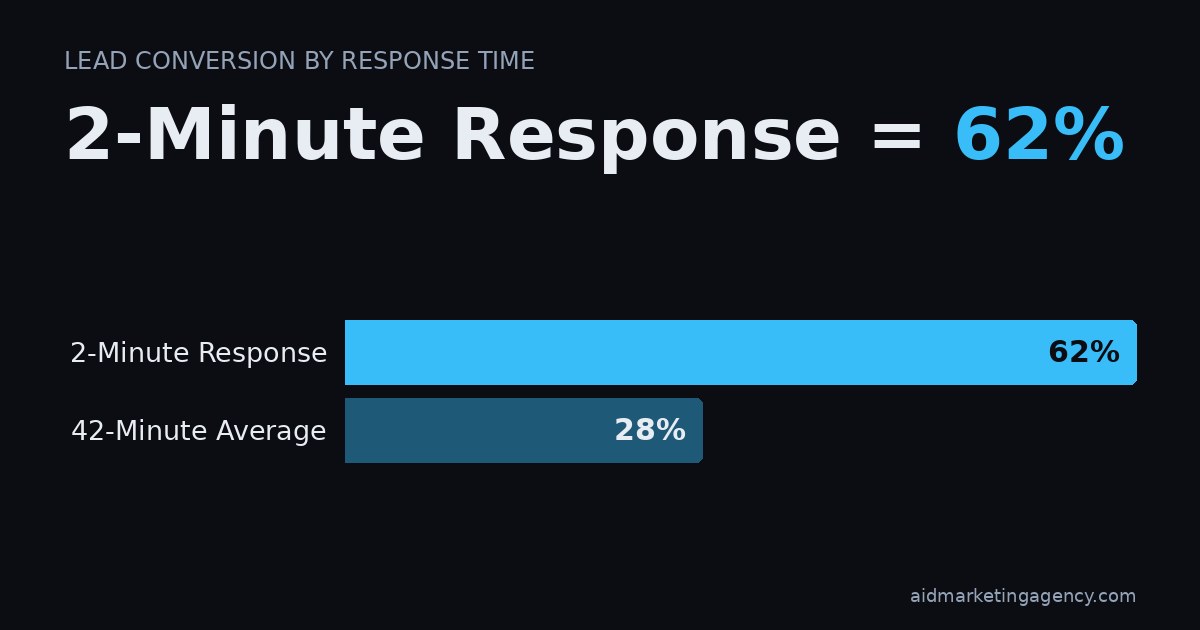
The clock starts the second a homeowner hits submit on your website or dials your number. Older research suggests that the odds of qualifying a lead fall dramatically when the first response slips from 5 minutes to 30 minutes (Lead Response Management Study, 2007). More recent data confirms this trend: contractors responding within 2 minutes converted 62 percent of leads, compared to just 28 percent for those hitting the 42-minute industry average (ServiceTitan, 2025). If your team treats a 30-minute delay as acceptable, you are effectively handing those jobs to the shop that picked up the phone first.
The first 5 minutes are where the money lives. After that, the lead starts shopping. They called three other contractors, and the one who answered is already scheduling the estimate. For a deeper look at why speed beats marketing spend, check out The 5-Minute Rule: Why Speed-to-Lead Beats Marketing Spend.
Sign 2: You Stop After One Call or One Message
A common pattern in many shops is the one-and-done approach. If a lead does not answer the first call, the record gets marked as dead. But the data consistently ties better results to repeated, multi-touch follow-up rather than a single attempt (Lead Response Management Study, 2007; Lead Response Management Report, 2007). Leads are rarely sitting by the phone waiting for your call. If you stop after one attempt, you are leaving revenue on the table simply because you did not try again when the homeowner was actually free.

Most homeowners are at work, driving, or dealing with kids when you call. A second call that evening, a text the next morning, an email the following afternoon: each touch increases the odds of connecting. The shops that win are the ones that build a cadence, not just a single dial.
Sign 3: You Do Not Separate Speed-to-Lead by Channel
Many contractors measure their response time based on when they finally get someone on the phone. This is a mistake. Speed-to-lead is defined as the time to the first outbound text, call, or personal email (ServiceTitan, 2025). If your team waits for a phone conversation before acknowledging the lead, you are ignoring the channel the customer likely prefers.

A missed-call text-back or an automated email response counts as a touch. If you are not using these channels to bridge the gap until a human can talk, your response time is effectively zero. The homeowner already moved on to the next contractor on their list.
For a breakdown of how AI receptionists, answering services, and voicemail compare on this front, see AI Receptionist vs Answering Service vs Voicemail: 7 Differences That Decide Who Books the Job.
Sign 4: Your Response Process Depends on Whoever Is Free
Reliance on heroics is not a strategy. When lead follow-up depends on whoever happens to be sitting at the desk or whoever is not currently on a roof, consistency vanishes. The gap between top-performing shops and the average is often a matter of process, not talent.
A structured process means every lead gets the same response regardless of who is working that day. That means a defined first-response time target, a set follow-up cadence, and a clear owner for every inbound channel. Without those three pieces, your lead pipeline has holes that no amount of hustle can patch.
The best shops treat lead response like a manufacturing line, not a pickup game. Every step is documented. Every role is assigned. Every lead enters the same funnel and gets the same touches in the same order. For a full framework on what to automate first, second, and never, see The 2026 Contractor AI Stack: What to Automate First, Second, and Never.
Sign 5: You Have No System for After-Hours and Missed Calls
A significant portion of home service calls lands after the office closes or when everyone is on a job. If a homeowner calls at 6:30 PM and gets voicemail, they are calling the next contractor before you even see the missed call notification in the morning.

This is where most lead leakage happens silently. You never see the leads you lose because they never become leads in your system. The call log shows a missed call, but nobody follows up because nobody knows it happened until it is too late.
A missed-call text-back is the simplest fix. When a call goes unanswered, an automated text fires back within seconds acknowledging the customer and opening a channel to book the job without a phone call. For the math on what a single missed call costs a roofer, see What a Missed Call Actually Costs a Roofer in 2026.
The 48-Hour Fix
Here is a concrete plan to plug the leaks in 48 hours.
Hour 0 to 2: Audit your current response time. Pull your last 50 inbound leads. For each one, find the timestamp of the lead and the timestamp of your first response. Calculate the gap. If you do not have this data, start tracking it today. You cannot fix what you do not measure.
Hour 2 to 8: Set a first-response target. The target should be under 2 minutes for phone leads and under 5 minutes for web form leads. Communicate this target to everyone who touches leads. Write it on a whiteboard if you have to.
Hour 8 to 24: Build a follow-up cadence. Define what happens on attempt 1, 2, 3, 4, and 5. A simple version: call within 2 minutes, text if no answer, call again at 5 PM, email that evening, call once more the next morning. Document it. Print it. Tape it to the wall.
Hour 24 to 48: Plug the after-hours gap. Set up a missed-call text-back so every unanswered call gets an immediate response. The goal is zero unanswered calls going into the night without a response. For the full playbook on contractor speed-to-lead systems, see AI Speed-to-Lead for Contractors: The 2026 Playbook.
The Hidden Leak Most CRMs Miss
There is a gap that almost no contractor talks about because almost no contractor sees it. The CRM logs a lead at 9:14 AM. The office manager calls that lead at 9:22 AM. The CRM shows an 8-minute response time. Looks fine.

But the homeowner actually filled out the web form at 8:47 AM. The form submission sat in an email queue for 27 minutes before anyone imported it into the CRM. The real response time was 35 minutes, not 8. The CRM timestamp measures when the lead entered your system, not when the homeowner raised their hand.
This happens constantly in shops that rely on manual lead entry from email or from a lead marketplace dashboard. The clock the homeowner experiences starts when they hit submit. The clock your CRM reports starts when your team creates the record. Those two clocks are rarely synced, and the gap between them is invisible in your reporting.
In many shops, the delay between when a lead source delivers the lead and when it appears in the CRM can be long enough to cost the job before the team even knows the lead exists. That delay is not tracked, not measured, and not discussed in the Monday meeting. It is pure leakage. The fix is simple: connect the lead source to the CRM with an automated pipeline so the record is created the instant the lead lands. No manual import step. No email queue. No gap.
For more on how to enrich leads the moment they arrive so your team knows who called before calling back, see Lead Enrichment for Trades: Knowing Who Called Before You Call Back.
Worked Example: What Lead Leakage Actually Costs
The following is an illustrative calculation, not a client result.
Say a roofing shop gets 100 inbound leads per month. The industry average response time is 42 minutes, and at that speed, 28 percent of leads convert (ServiceTitan, 2025). That means 28 jobs booked per month.
Now say that same shop drops its first-response time to under 2 minutes. At a 62 percent conversion rate, those same 100 leads produce 62 jobs. The difference is 34 additional jobs per month, just from responding faster.
At an average residential roofing job value of $8,000 to $12,000 (Angi, 2025), those 34 additional jobs represent $272,000 to $408,000 in additional monthly revenue. The lead volume did not change. The marketing spend did not change. The only variable was how fast the phone got answered.
This is why speed-to-lead is not a marketing tactic. It is an operations tactic. The leads are already coming in. The question is whether your shop is built to catch them.
By Ryan McNally | About Ryan | Published 2026-01-20 | Updated 2026-01-20